Mobile Home Plumbing Repair, Job by Job
The short version
- Supply branches here are small by design: 24 CFR 3280.609(f)(1) allows 3/8 inch outside diameter on a line feeding one fixture, so house sized stops often will not thread on.
- Every plastic water pipe and fitting used in the fix has to be listed for hot water (3280.609(d)(1)(i)), which rules out much of a general hardware shelf.
- The job is not done when the leak stops. HUD asks that splits and tears in the bottom board be resealed and every edge of the repaired area sealed (24 CFR 3285.804).
- Gas appliances, sealed combustion closets and 240 volt circuits are licensed work. Shut off the gas or the breaker before opening anything, then hand it over.
- Census ACS 2024 one year estimates put roughly 4.6 million occupied units in this category at pre-2000 construction, so most of this stock is repairing rather than aging quietly.
Most mobile home plumbing repair falls into 6 recurring jobs, and 4 of them sit under the floor rather than behind a wall. HUD gives these homes a single 3 inch drain outlet and supply branches as small as 3/8 inch.
The fixture above the floor looks ordinary. The pipe feeding it, its supports and the skin that closes over it again are set by a federal standard written for this housing type.
Repair here is not house plumbing at a smaller scale
Plumbing rules for these homes sit in 24 CFR part 3280, subpart G. The Standards HUD writes run from body and frame through thermal protection, plumbing, electrical and fire safety, so a fixture swap can raise a code question a stick built house never does.
Sizing shows it fastest. Where a branch serves one fixture, the table in 3280.609(f)(1) drops to 3/8 inch outside diameter, and that smallest row is capped at a 6 foot run.
| Fixtures on the branch | Nominal tubing | Outside diameter | Iron pipe size |
|---|---|---|---|
| 1 | 1/4 in | 3/8 in | 1/2 in |
| 2 | 3/8 in | 1/2 in | 1/2 in |
| 3 or 4 | 1/2 in | 5/8 in | 1/2 in |
| 5 or more | 3/4 in | 7/8 in | 3/4 in |
Minimums from the table in 24 CFR 3280.609(f)(1), where galvanized screw piping also gets a floor of its own: 1/2 inch iron pipe size.
The system was built for 80 psi at the inlet (3280.609(a)(1)), and the installation standard requires a pressure reducing valve above that (24 CFR 3285.603(b)). A well or park main above it keeps opening the same fittings.
If flow is the complaint, read the causes behind narrow supply lines and long branch runs first. A hose bib gauge over 80 psi turns the job into a reducing valve quote.
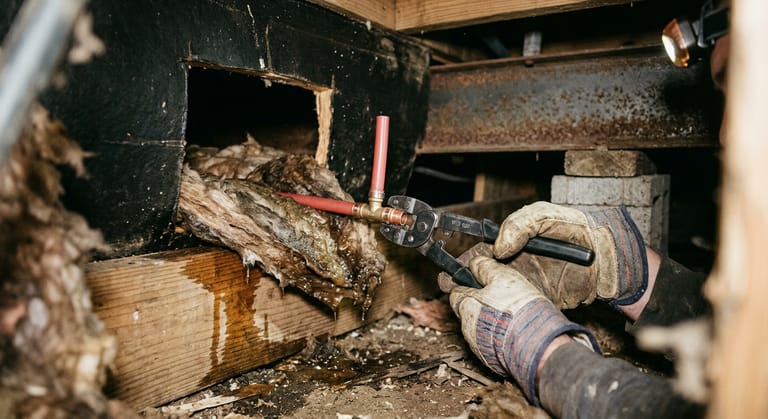
The 6 repairs that come up most in the field
| Plumbing job | What usually fails first | Where to stop |
|---|---|---|
| Supply leak under the floor | A fitting, or a split at a support | Locate, shut off, price the repipe |
| The one drain outlet backing up | Site assembled pipe that lost its fall | Cable from a cleanout, not the connector |
| Water heater in the closet | Relief valve, element, thermostat, thermocouple | Anything gas, vented or 240 volt |
| Crossover and heat tape circuit | The field installed crossover | Wiring and cable selection |
| Bottom board closure | Tears left open by an earlier fix | Nothing, if you can reach it safely |
| Stops, traps and fixture valves | Stops no house valve fits | Measure before buying |
Materials are not open season. Section 3280.609(d)(1) allows copper in Type K, L or M, standard weight brass, galvanized wrought iron or steel, and plastic that is approved or listed, with a hot water listing required besides on every plastic line and fitting (3280.609(d)(1)(i)). That clause is what a weekend plumbing fix breaks most often.
Two more traps under the floor: piping and wiring may not share holes, and plastic pipe may not sit where an appliance radiates heat onto it (3280.603(b)(7)).
Fixture work sits at the easy end of that list, where most owners start. Swapping the pan and flange is covered step by step in replacing a mobile home toilet, the tight cabinet under a kitchen or bath basin in what fits a mobile home sink, and the shallow pans and offset drains in tub and shower plumbing.
The belly is part of every under-floor repair
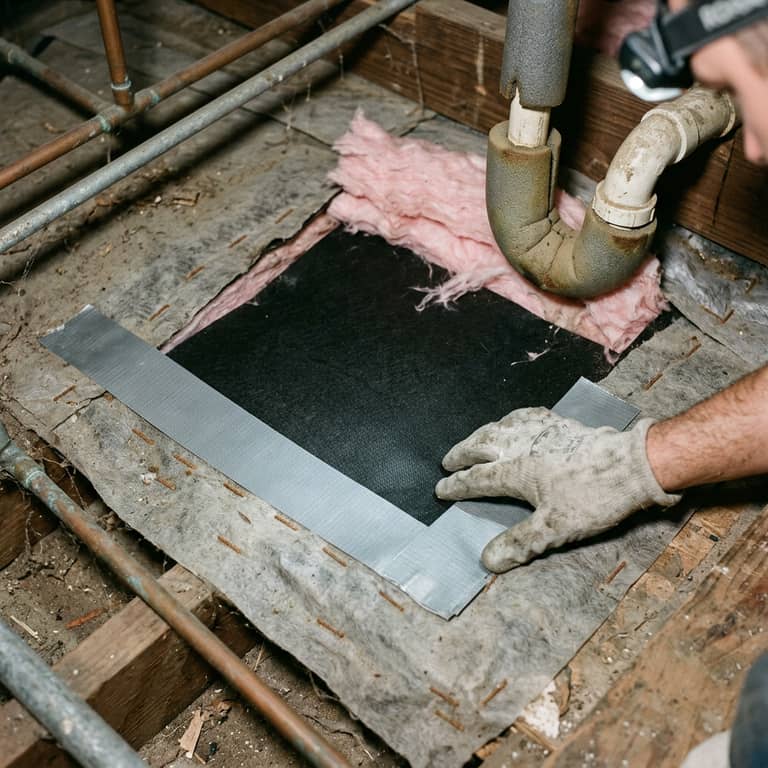
Pipes here live in the cavity closed off by the bottom board, so the work has two halves: the pipe, and the skin. HUD covers the second at 24 CFR 3285.804. Nothing closes until missing insulation is back in place; from there the section wants splits and tears taped or patched by the manufacturer's method, P-traps insulated and covered, and the edges of the repair sealed.
Support spacing decides whether the fix lasts. Horizontal plastic water piping needs support every 3 feet, drainage piping every 4 feet (3280.608(b)), and the hangers holding it may not crush, cut or scuff the pipe (3280.608(c)(3)).
Patch a small tear yourself if you can get under the home safely. Once the opening spans joists, or wet insulation is in it, doing it twice costs more than the call.
Water heaters and gas: the licensed line, plainly
The water heater closet is where this stops being a homeowner project. Keeping the combustion system and the air inside the home fully apart is the rule, met with a direct vent (sealed combustion) appliance or an enclosure that has no door, no access panel and nothing open to the living space (24 CFR 3280.709(d)). Hence the outside access door.
Relief valve rules are equally exact. Whichever is lower, 150 psi or the tank's rated working pressure, is where relieving starts, with the temperature trigger at 210 degrees F or under. The discharge keeps full size out to the exterior, never under the home (3280.609(c)(1)).
Talk it through with a mobile home plumber
Call (800) 555-0176Free to dial. You reach a licensed plumber who works on manufactured homes.Partner plumbers who service manufactured homes- Plumbers who actually work on manufactured homes
- Line answered day and night, all year
- Dialing costs you nothing
- Price talk happens between you and the plumber
When a repipe beats another patch: plumbing installation on your mobile home
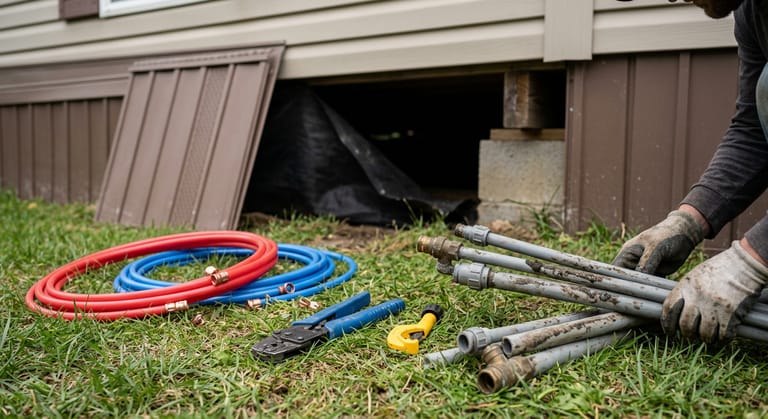
Polybutylene never left the federal materials list. The current text of 3280.604(c)(3) still names ASTM D3309 for polybutylene hot and cold water systems, next to CPVC and the PEX standards ASTM F876 and F877 that HUD brought current in a final rule of December 9, 2013 (78 FR 73966).
Repiping is routine permitted plumbing work. Washington State's Department of Labor and Industries keeps an alteration permit type plus its own pre-inspection form, F622-053-000, covering replacement of polybutylene water piping in a manufactured home. One state's process, but it shows what inspectors look for.
Three lines from it show how careful the work is: a bored hole in a floor joist keeps 2 inches clear of top and bottom edges and stays no wider than one third of the joist depth, insulation returns at its original R-value, and the bottom board gets a patch expected to last as long as what it replaces.
Two leaks in one season, or pipe that splits whenever a fitting is disturbed, is where patching stops paying. Ask for a repipe quote and a patch quote on one visit, then weigh both against the home's age.
Mobile home plumbing inspection: what actually gets checked
Under the standard an inspection means gauges, not a flashlight. Water piping has to hold 80 psi, give or take 5, for a full 15 minutes without the gauge dropping (3280.612(a)), and the drain, waste and vent system gets one of three alternative tests (3280.612(b)).
Underneath, that board is inspected for loosening, damage and tears before anything closes (3285.804). The shutoff valve required by 3285.603(c) has to be identified and reachable, its riser under the home or right beside it.
Plumbing services a mobile home needs, and a house does not
Three items belong on the scope and rarely reach a general service ticket. Freeze protection first: insulation or equivalent protection is required on any pipe or fixture exposed to freezing (3280.603(b)(4)), and a heat tape or pipe heating cable belongs under the home only where its listing and certification cover that use (3285.603(d)(3)). CPSC said in 1990, on six years of data, that more than half of the heat tape fires in its count involved mobile homes and trailers.
Second, drainability: everything except the fixture trap must be designed to drain (3280.603(b)(5)), which is what makes a winter blowdown possible. Third, belly closure, priced as its own line.
If the drain is the complaint instead of the supply, the single outlet at 3280.610(c)(1) changes the approach, and clearing that one sewer line has a method of its own.
How to vet plumbing contractors for your mobile home
Searching "mobile home plumbing repair near me" returns mostly general plumbers, which is fine if they answer three questions well. Do they stock small diameter stops and supply tubing. Do they carry bottom board patch material. Will belly closure appear as a priced line on the quote.
Ask for the scope in writing before tools come out: pipe material and listing, support spacing, insulation replaced at the same R-value, and how the bottom board gets closed. Anyone who answers those without hesitating has done this plumbing work before.
Where to stop, and who to answer to
Homeowner side: locating a leak, shutting water off at the riser, changing a stop or a trap, patching a small tear, swapping a water heater element with the breaker off. Past that, and especially with gas, venting or 240 volt work, it is licensed territory, and any mobile home plumbing repair that reopens the floor should be quoted with closure included.
Age argues for asking early. Census Bureau one year estimates for 2024 put roughly 4.6 million occupied homes in this category at pre-2000 construction, and about 1.6 million before 1980. Census folds boats and RVs into that same label, so the counts are approximate.
Call (800) 555-0176 when water shows under the floor, when the same fitting fails twice, or when a quote arrives without a word about the belly. The call is free at your end, and the plumbing partner picking it up is licensed and spends ordinary weeks under manufactured homes.
Talk it through with a mobile home plumber
Call (800) 555-0176Free to dial. You reach a licensed plumber who works on manufactured homes.Partner plumbers who service manufactured homes- Plumbers who actually work on manufactured homes
- Line answered day and night, all year
- Dialing costs you nothing
- Price talk happens between you and the plumber