How to Snake a Mobile Home Sewer Line
The short version
- One outlet per manufactured home is all the federal standard allows (24 CFR 3280.610(c)(1)), so a single blockage stalls every fixture at once.
- Put the cable in above the plug. A lifted toilet opens the 3 inch drain HUD sets under a water closet, and a cleanout opens the line itself.
- Repeat blockages are usually grade. Horizontal drain piping must fall at least 1/4 inch per foot toward the outlet (24 CFR 3280.610(h)).
- Plastic drain piping under the floor needs support every 4 feet (3280.608(b)), and a sagging line holds water that packs the same plug again.
- The pipework below the floor is often assembled on site, not in the factory (3280.610(c)(5)), which is where lost fall usually comes from.
Snake a mobile home sewer line from a cleanout or a lifted toilet, never from the connector out at the skirting. HUD gives these homes a single drain outlet, 3 inches wide at minimum, so one plug stalls every fixture.
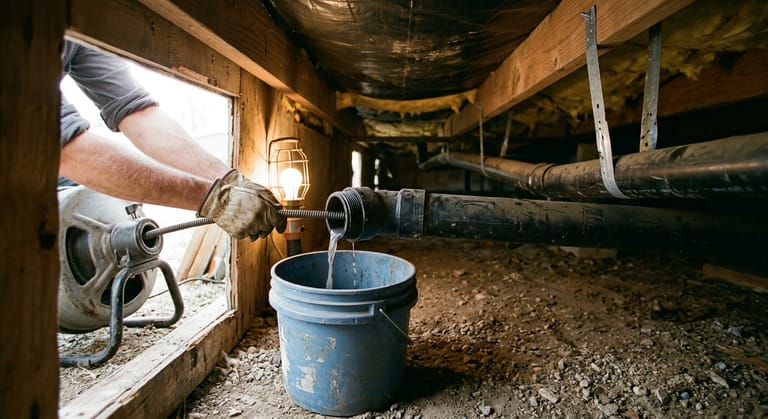
That one outlet shapes the whole job. The cable goes in above the blockage and works down toward it, because there is no room to drive a machine uphill from the yard side of a manufactured home.
One drain outlet is why everything stops together
The count is the whole story. Paragraph (c)(1) of 24 CFR 3280.610 gives a manufactured home one drain outlet and permits no second. A site built house branches into a buried main; here every fixture feeds one line out through one connector.
Size follows. That connector starts at 3 inches inside diameter, never narrower than the pipe it meets, and carries a watertight cap (3280.610(c)(3) and (c)(4)). HUD keeps the outlet's surroundings open too: 3 inches from the structure in any direction, 18 inches unrestricted in front (c)(2).
So one mobile home main sewer line clog shows up in every room at once. The tub gurgles on a flush, the washer pushes grey water into the shower pan, and the lowest fixture floods first. One slow sink is a fixture problem. Everything slow together is the shared line.
Where to put the cable in
A cable has four ways in, and they do not rank the same. Diameter decides, and so does the way waste travels once the plug lets go.
| Entry point | What it reaches | Why it gets picked |
|---|---|---|
| Cleanout at the upper end | The horizontal line back toward the fixtures | Full size opening, right direction of travel |
| Toilet lifted off the flange | The 3 inch fixture drain set under a water closet | Largest opening in the floor (3280.610(e)(4)) |
| Vent terminal | The stack straight down into the line | Awkward: a roof vent clears the roofline by 2 inches (3280.611(f)(1)) |
| Drain connector at the skirting | The site sewer hookup only | Last resort, and it pushes debris the wrong way |
Skip the sink trap arm. A lone lavatory is allowed a fixture drain of just 1 1/4 inches, two or three fixtures one of 1 1/2 inches (3280.610(e)), so a heavy cable in tubing that narrow packs the blockage tighter. If a trap arm is your only opening, hand the job over.
How to snake a mobile home sewer line, step by step
- Stop everything going down. No taps, no washer, no dishwasher. Water added now has nowhere to go but the floor cavity.
- Bail the fixture down. Through standing waste you cannot see the cable come back, so you miss what it hooks.
- Open the entry and look. Pull the cleanout plug slowly, bucket underneath. A plug under head pressure says the line is full and the blockage sits downstream.
- Feed by hand first. Push cable until it meets resistance, then note how far it went. A short push is still a fixture branch; a long one puts the trouble near the outlet.
- Turn the machine slowly. Let the head cut rather than drive it. Listed Schedule 40 ABS and PVC sit on the permitted materials list here (3280.610(b)(1)), and thin wall plastic at a tired joint gives way under a cable spun hard.
- Flush long and watch the low fixture. Run a tub several minutes and stand at the shower pan. Water rising again means the plug moved rather than cleared.
That is the safe limit of a rented machine. Cutting into the belly, resetting a flange or chasing a blockage past the outlet is where partner plumbers take over, on a line that is free and answered around the clock.
Talk it through with a mobile home plumber
Call (800) 555-0176Free to dial. You reach a licensed plumber who works on manufactured homes.Partner plumbers who service manufactured homes- Plumbers who actually work on manufactured homes
- Line answered day and night, all year
- Dialing costs you nothing
- Price talk happens between you and the plumber
How to unclog the main sewer line in mobile homes when the cable stops
Three findings say the cable is not the answer in these homes. A plug that returns within days. A cable stopping hard at the same distance every attempt, which reads as a fitting, a sag holding solids, or a joint out of alignment. Water surfacing under the floor instead of draining.
At that point the question is grade, not blockage. Horizontal drain piping needs a uniform 1/4 inch of drop per foot toward the outlet. The single concession is 1/8 inch, and it takes a structural reason the steeper fall will not fit plus a full size cleanout at the upper end (3280.610(h)). Anything flatter carries solids nowhere.
Camera and locator work settles it in an hour. Ask for the footage and depth reading, not a verdict. If the finding is a collapsed section, the fix is pipework under the home, and what plumbing repair on these homes involves is worth reading before anyone quotes.
Sag, torn belly and the plug that keeps coming back
Unsupported pipe is the usual cause under an older home. Four feet is the widest a horizontal plastic drain run may go between supports, and the hangers holding it may not compress, cut or abrade the pipe (3280.608(b) and (c)(3)). The South Carolina Weatherization Field Guide checks 4 foot spacing on gas, water and electrical lines instead.
Once the bottom board tears, straps let go and a plastic line bellies between joists. Tape or a patch over every split, then a sealed edge around each repaired area: that is 24 CFR 3285.804. Patching the skin is not cosmetic, it holds the drain lines at the fall they were built with.
Mobile home sewer line installation: how to run a new line
Replacement is a defined job, not a creative one: the standard fixes most variables in these homes before pipe is bought.
Pipe choice is closed. Cast iron, brass, galvanized steel, copper tube DWV and listed Schedule 40 ABS or PVC qualify; anything else must be a listed or approved material (3280.610(b)(1)). Fall holds at 1/4 inch per foot toward the outlet, or 1/8 inch where that cleanout sits upstream. Horizontal support returns every 4 feet (3280.608(b)). The outlet keeps its 3 inch minimum, and its 18 inch clearance has to survive the new skirting.
Venting travels with the drain. Three fixtures is the ceiling on a 2 inch wet vented system, and the pipe itself never falls below 2 inches, nor below one size above the largest trap or fixture drain feeding it (3280.610(f)). Terminals and mechanical vents sit on the drain and vent page.
Permits are state business, not federal. Washington State Labor and Industries, for one, keeps a standing alteration permit and pre inspection checklist for plumbing alterations on manufactured homes, polybutylene repiping included. Expect an inspector wherever you live.
What is worth paying for, and when to call
Age argues for a look. Census Bureau ACS 2024 one year estimates count roughly 4.6 million occupied units in this category built before 2000, about 1.6 million of them before 1980. Census lumps boats, RVs and vans into the same label, so the counts are close, not exact. Site assembled drain lines that old have had a long time to settle.
Call (800) 555-0176 when the cable stops in the same place twice, when water shows under the floor, or when a fixture trap is the only opening left. The dial costs nothing, and the voice answering belongs to a licensed plumber whose ordinary week is manufactured housing.
Talk it through with a mobile home plumber
Call (800) 555-0176Free to dial. You reach a licensed plumber who works on manufactured homes.Partner plumbers who service manufactured homes- Plumbers who actually work on manufactured homes
- Line answered day and night, all year
- Dialing costs you nothing
- Price talk happens between you and the plumber