Plumbing Supplies for Mobile Homes, Part by Part
The short version
- The HUD Code lets a supply branch feeding one fixture run 3/8 inch outside diameter, so a stop valve sized for a house may not thread on.
- Plastic pipe and plastic fittings only qualify here if the listing covers hot water, which rules out much of the general shelf.
- Heat tape has to be listed and certified, and Frost King refuses its own cable kits on a manufactured home feed line.
- Water heater parts follow the appliance: side inlet, side relief valve, roof jack kit ordered separately by vent length.
- Bottom board patch material counts as a supply here, because HUD asks a patch to last as long as the belly it repairs.
No, most mobile home plumbing supplies are not the parts a site built house takes. The sizing table in 24 CFR 3280.609 allows supply tubing as small as 3/8 inch outside diameter, and the whole home drains through one 3 inch outlet.
That is the short answer. The long one is a shopping list that begins with a tape measure, not a shelf label.
Why the part number beats the aisle sign
The HUD Code at 24 CFR part 3280, subpart G describes what the builder installed. A repair decades later answers to state and local rules.
Census ACS 2024 one-year estimates put roughly two thirds of occupied units in the mobile home category at built before 2000, so the fitting in your hand is often older than the standard on the new box.
Photograph the old part in place, beside a tape. Hand off anything you cannot name by sight.
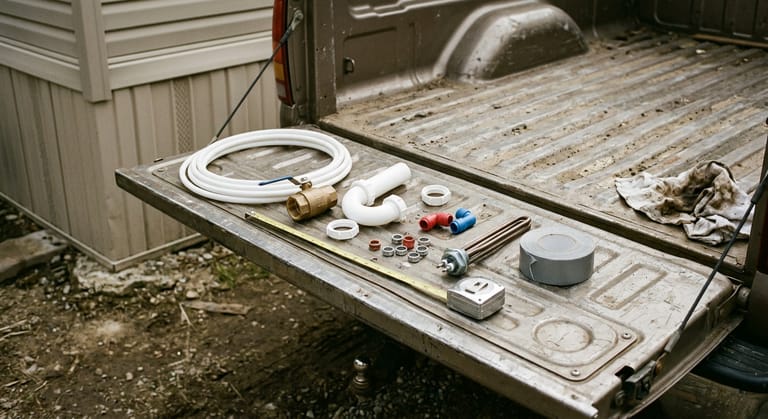
The 10 supplies worth a source before you need one
| Supply | Different here | Check first |
|---|---|---|
| Supply tubing | Sized smaller than a house | Outside diameter, listing |
| Crossover connector | Joins two half sections | Type the builder specified |
| Fresh water inlet cap | Plug stays attached | 3/4 inch thread |
| Full flow shutoff | At the riser, not the sink | Gate or ball valve |
| Pressure reducing valve | Designed inlet pressure 80 psi | Static pressure at the lot |
| Tailpieces and P-traps | Minimums from 1 1/4 inch | Fixture feeding the trap |
| Drain connector and cap | Outlet is 3 inch minimum | Cap matched to outlet |
| Listed heat tape | Listing is a federal condition | Wording on the carton |
| Bottom board patch, tape | Patch must outlive the repair | Material matched to belly |
| Water heater element | Wattages differ from a house | Nameplate volts and watts |
Mobile home plumbing supplies are ordinary hardware in sizes and listings a general shelf rarely carries.
Mobile home pipes and what the plumbing standard allows
Copper in types K, L and M, galvanized steel, galvanized wrought iron, standard weight brass: 3280.609(d)(1) takes water pipe in any of them, plus approved and listed plastic. Inside a manufactured home, plastic counts only where its listing covers hot water, fittings as much as pipe.
Plastics named at 24 CFR 3280.604 include CPVC to ASTM D2846, PEX to ASTM F876 and F877, and polybutylene to ASTM D3309. Polybutylene was never struck from that list, one reason it keeps surfacing under these floors. HUD's rule of December 9, 2013, at 78 FR 73966, brought the PEX references current.
Support belongs in the cart too: 3280.608(b) asks horizontal plastic water piping carried every 3 feet, drainage every 4 feet, on hangers that do not compress it. One run between two visible fittings is homeowner work. A repipe is not.
Fittings a mobile home takes that house plumbing does not
Two have no equivalent in a house. The crossover: 3280.609(b)(1) calls for connectors designed for the purpose where a home comes in two or more sections, with matching caps when the halves sit apart. And the fresh water inlet, a 3/4 inch threaded connection tagged Fresh Water Connection or Fresh Water Fill.
Outside, 24 CFR 3285.603 wants the shutoff identified, reachable, full flow in the gate or ball pattern, on a riser under or beside the mobile home. Past 80 psi, common on park mains and rural wells, a pressure reducing valve is mandatory. Learn where the shutoff sits before you need it in the dark.
Gas connectors are not in this aisle. Part 3280 pulls in IAPMO TS 9 and ANSI Z21.75, written for gas supply connectors on manufactured homes. Fitting one is licensed work. If you smell gas, shut the supply off at the tank or meter and step outside before calling.
Mobile home fixtures and the plumbing they sit on
Fixtures are ordinary sanitary ware; what sits under them is not. A lavatory gets the thinnest tailpiece 3280.607(a)(3) allows, 1 1/4 inches. The rest starts at 1 1/2: multi compartment sinks, dishwashers, clothes washers, laundry tubs, bathtubs, showers. Section 3280.610(e) sizes the drain: 1 1/4 inches for a lavatory, 1 1/2 for two or three fixtures, 2 inches for four or more individually vented, 3 inches for a water closet.
Vent geometry is tighter than expected. The table at 3280.611(c)(5) caps trap to vent distance at 4 feet 6 inches on 1 1/4 and 1 1/2 inch drains, 5 feet on 2 inch, 6 feet on 3 inch. Air admittance valves are permitted only as a secondary system, expected to be ASSE 1051 devices, and only where a vent of at least 1 1/2 inches still ends outside. A drawing of how the runs connect settles most of it. Swapping a trap is a basin wrench; moving a drain is trade work.
Talk it through with a mobile home plumber
Call (800) 555-0176Free to dial. You reach a licensed plumber who works on manufactured homes.Partner plumbers who service manufactured homes- Plumbers who actually work on manufactured homes
- Line answered day and night, all year
- Dialing costs you nothing
- Price talk happens between you and the plumber
Water heater parts are a catalogue of their own
These tanks are built around supply from underneath. Reliance is blunt about its mobile home layout: water in at the side, out at the top. A. O. Smith explains why: its 3/4 inch cold inlet is on the side because supply comes from below the floor. Richmond's co-axial manufactured housing unit breaks the pattern, hot and cold on top.
Richmond also puts the relief valve in a side location, and A. O. Smith's spec sheet says no option exists for a top mounted T and P. Venting is bought separately: four roof jack kits by vent length.
Two jobs are not yours. Gas appliances, their venting and any 240 volt connection belong to a licensed professional. Before opening an electric unit, switch the breaker off and confirm it is dead. Before touching a gas unit, close the gas valve.
Elements are the trap. State catalogues a 40 gallon tank at 120 volts and 3,000 watts, Reliance a 40 gallon at 240 volts and 3,800 watts, and Richmond rates recovery at 17 gallons per hour on 3,500 watts against 21 on 4,500, both figures at a 90 degree F temperature rise. Fit a generic 4,500 watt element to a 3,800 watt tank and it is the circuit you changed. HomeGuide's national figures: $100-$350 an element, $50-$300 a relief valve, $45-$150 an hour for labor.
Heat tape is a listed product, not a generic one
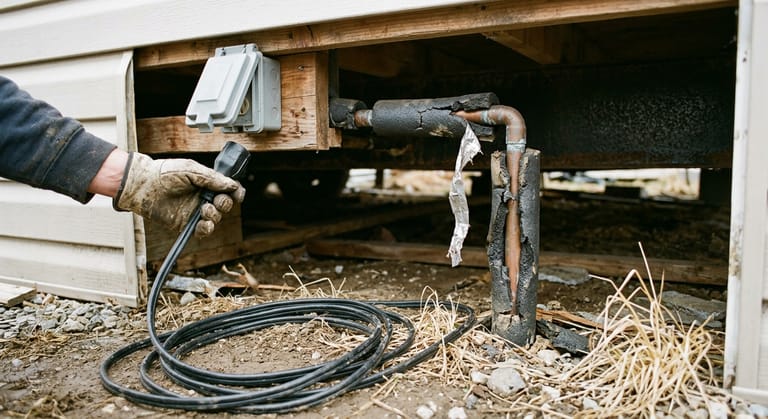
Federal rules treat pipe heating cable as a specified component. Only a cable listed and certified for the job may go on the pipe (3285.603(d)(3)). And 3280.603(b)(4) makes the manufacturer state in writing that heat tape must be listed for manufactured homes. UL keeps two separate outlines, UL 1462 for mobile home pipe heating cable and UL 2049 for residential, both dated June 21, 2006.
Brands draw their own lines. Asked whether its Automatic Electric Heat Cable Kits suit a mobile home feed line, Frost King answers no, calling those lines too flexible and too thin for the heat. Chemelex sizes its Frostex cable with separate tables for metal pipe and plastic pipe.
Two CPSC positions travel well. The 1988 message: buy for the pipe, since material, diameter and length decide the cable. In 1996 it urged swapping uncertified tape over three years old for certified, plus a yearly look: discolored surface at the plug first, then charring, cuts, bare wire. That clock covers uncertified cable only. CPSC also said most people should have an electrician look. More on sizing the cable.
Belly patch material counts as a supply here
The bottom board is plumbing protection, not trim: water lines and floor traps live inside it. HUD sets one material spec. Run the Beach Puncture Test on the bottom board, patches and all, and 3280.305(g)(6) wants 48 inch-pounds of puncture resistance or better, a patch lasting as long as the material it joins. Duct tape is not that.
Method is 24 CFR 3285.804: missing insulation back in before closure, splits resealed with tape or patches by the manufacturer's instructions, every P-trap insulated and covered, all edges taped or sealed. Deeper work sits in what belly repair involves.
What a search for mobile home plumbing parts near me turns up
Usually two kinds of result: a general counter with the fixture but not the fitting, and a manufactured housing dealer or park supplier who has both and does not advertise. A search for mobile home plumbing supplies near me is worth running twice, once for retail and once for the dealer network.
- Photograph the part in place, then out, beside a tape.
- Record outside diameter and thread, not the brand.
- Read the data plate for builder and model.
- Take the old part. Shape sells better than words.
- Ask whether the plastic is listed for hot water.
Two counters failing to name it is a signal.
Before anything goes into the cart
Most of what goes wrong with mobile home plumbing supplies is bought correctly and fitted into the wrong system: right tubing, house sized stop; right wattage for a house, wrong for the tank. Measuring first fixes most of it, and common repairs and what they involve covers the jobs these parts belong to.
When the leak is the question, not the part, calling beats reading. Dial (800) 555-0176. It is free, and a licensed plumber who works on manufactured homes picks up, names the part, and says whether it is yours to fit.
Talk it through with a mobile home plumber
Call (800) 555-0176Free to dial. You reach a licensed plumber who works on manufactured homes.Partner plumbers who service manufactured homes- Plumbers who actually work on manufactured homes
- Line answered day and night, all year
- Dialing costs you nothing
- Price talk happens between you and the plumber