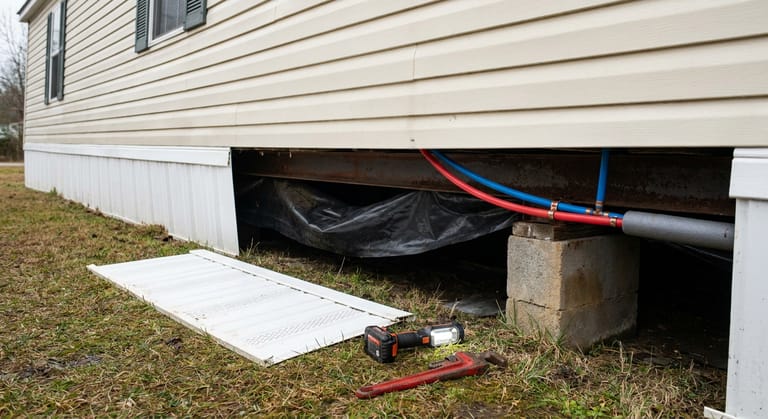
Mobile home plumbing runs under the floor, which changes every repair: the HUD code allows one drain outlet per home (24 CFR 3280.610) and requires a listed water heater. What follows is field practice on manufactured housing, not advice from a house with a basement.
Census counted 6.6 million occupied mobile homes in 2024, 5 percent of all occupied housing. Seven weak points in that plumbing draw most of the calls.
Where mobile home plumbing starts, and where it shuts off
Water arrives through one 3/4 inch threaded inlet that 24 CFR 3280.609 requires to be tagged Fresh Water Connection. The valve that stops it is not under a sink: HUD's installation standard puts the riser and its full flow gate or ball valve underneath or beside the home (24 CFR 3285.603).
Branches run narrower than site built work. The sizing table in 3280.609 permits tubing as small as 3/8 inch outside diameter feeding one fixture, capped at six feet, and 80 psi is what the system was built around.
Layout is on how supply, drain and vent lines run under the floor and finding the main shutoff.
The water heater is the part most often bought wrong
Under 24 CFR 3280.609 a home with a kitchen sink and a tub or shower needs a listed water heater, and 3280.709 requires fuel burning appliances to be sealed off from the interior air, which is why the tank sits behind an outside door.
| Tell | What it means | Source |
|---|---|---|
| Cold inlet low on the side | Supply comes from under the floor | A. O. Smith |
| Sealed combustion or sealed closet | Combustion air from outdoors | HUD, 3280.709 |
| 0 inches at the sides | A wider tank will not fit | A. O. Smith manual |
What the swap runs. HomeGuide puts standard tank replacement at $600-$3,100 installed, then adds $125 to $300 per labor hour for cramped spaces like closets, which describes this closet exactly. Start with [choosing and sizing a listed water heater](/water-heaters/).
Gas and 240 volt connections belong to a licensed pro. Shut the valve or the breaker first.
Freeze protection is a system, not a product
Nothing here sits over a warm basement, so 3280.603 makes freeze protection a design duty: piping subject to freezing has to be insulated or protected. Three things carry that load.
- Control the airflow, do not seal it. HUD asks that skirting vents in freezing regions be the adjustable kind (3285.505); dryer vents and combustion air inlets must stay open.
- Insulate the pipe, not the floor above it. Weatherization field guides tell crews never to put insulation between a supply line and the living space; backwards, the batt holds house heat off the pipe.
- Let a tap drip in a hard freeze. The National Weather Service recommends it to relieve pressure between the faucet and an ice plug, not to warm the pipe.
Detail sits on thawing a frozen line without splitting it and the fall drain down sequence.
Talk it through with a mobile home plumber
Call (800) 555-0176Free to dial. You reach a licensed plumber who works on manufactured homes.Partner plumbers who service manufactured homes- Plumbers who actually work on manufactured homes
- Line answered day and night, all year
- Dialing costs you nothing
- Price talk happens between you and the plumber
Heat tape earns more caution than any other part
In 1990, reviewing six years of data, CPSC said over half the heat tape fires it studied involved mobile homes and trailers. Its totals are unsettled: the 1988 to 1990 releases estimated about 3,300 residential fires and 20 deaths a year, the 1996 release about 1,500 fires and 10 deaths.
Three checks before winter. CPSC urges replacing uncertified tape over three years old with cable certified to UL, CSA or FMRC standards, which is not a blanket three year clock on certified cable. It asks for a yearly look at the plug for discoloration, charring or bare wire, and says most people should have an electrician do it. Frost King refuses its own constant wattage kits on a mobile home feed line, calling that pipe too thin and flexible for the cable.
The circuit is built in: 3280.806 puts a ground fault protected receptacle on the underside within 2 feet of the cold water inlet, and 3285.603 permits only listed, certified cable. Sizing and wrapping are on choosing and installing heat tape.
The belly board is plumbing protection, not skin
The sheet under the floor is what the code calls the bottom board, and 3285.804 treats repairing it as plumbing work: splits resealed by the manufacturer's method, insulation back in before closure, floor traps checked to be insulated and covered.
A patch has a standard to meet. Under 3280.305 bottom board material must survive 48 inch pounds of puncture in the Beach Puncture Test, and patch life must equal the life of the material it repairs. Tape over a hanging tear does not clear that bar.
More on belly wrap and underbelly repair.
Drains, vents and one outlet
A whole house backing up at once is normal here, because 3280.610 gives each mobile home one drain outlet, at least 3 inches across. That section also lets the lines under the floor be assembled on site instead of in the factory, which is where sagging runs start.
Vents are shorter than expected: 3280.611 asks 2 inches above the roof and allows sidewall termination. Smell and slow drains are traced on the drain and vent system.
Repipes, repairs, and where reading should stop
Age drives the work. In the 2024 Census figures, which pool mobile homes with boats and RVs, roughly 45 percent of the occupied stock falls in the 1980 to 1999 build band, so the median one is 25 to 45 years old. Polybutylene has never been struck from the federal standard at 3280.604, so it remains an accepted material and still turns up in repipe work; Washington State keeps a checklist for it, form F622-053-000.
Tightening a supply nut, insulating an exposed run or clearing a trap is fair weekend work on mobile home plumbing. Opening the belly, cutting the drain outlet, moving a gas water heater or rewiring heat tape is not.
No charge for the call. (800) 555-0176 reaches a licensed partner plumber whose ordinary week includes mobile homes like yours, at any hour, and you settle the price with that plumber before anything is opened up. Haverlane writes, and a call that becomes a job sends a referral fee back here, paid out of the plumber's own advertising money and taken from nothing you are charged. Start symptom by symptom in the mobile home plumbing repair index.
Talk it through with a mobile home plumber
Call (800) 555-0176Free to dial. You reach a licensed plumber who works on manufactured homes.Partner plumbers who service manufactured homes- Plumbers who actually work on manufactured homes
- Line answered day and night, all year
- Dialing costs you nothing
- Price talk happens between you and the plumber