Mobile Home Water Shut Off Valve: Where It Is and How to Change It
The short version
- HUD's installation standard puts an identified, reachable shutoff ahead of the home's inlet, on a riser underneath or adjacent to the structure.
- Fastest way to find it: open the skirting panel, locate the 3/4 inch fresh water inlet, then look within 2 feet for the heat tape receptacle the code puts beside it.
- In freezing areas the standard names shutoff valves among the parts that must be insulated or otherwise protected.
- Roughly two thirds of occupied homes in the Census mobile home category were built before 2000, so seized hardware is a normal finding rather than a surprise.
- No credible national price exists for this swap; HomeGuide puts plumber labor at $45 to $150 per hour with call out minimums of $50 to $200.
Start outside, not in a cabinet. On a HUD code home the mobile home water shut off valve never sits indoors: it rides a riser under the floor or just past the skirting, full flow, gate or ball. Plan on a crawl.
What the federal standard owes you
Two pieces of federal text settle this. HUD's installation standard at 24 CFR 3285.603(c) has three parts: the valve belongs in the line from site supply to the home's inlet, its riser stands underneath the structure or beside it, and the body passes full flow, so gate, ball type or equivalent. HUD's own words for the result: "an identified and accessible shutoff valve".
The construction standard covers what a factory skipped: with no master cold water shutoff reachable on the main feeder line, 3280.609(b)(1) makes the maker's instructions call for one in the supply line beside the home.
Code owes you the hardware. Whether it is still reachable is the next twenty minutes' work.
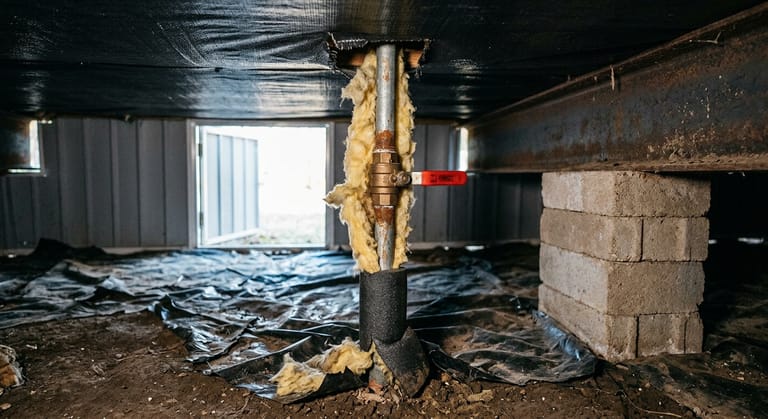
Mobile home water shut off valve location, place by place
Four spots account for nearly every home, and only the first three are yours.
| Where to look | What you are looking for | Federal basis |
|---|---|---|
| Under the floor, front third of the home | Upright pipe carrying a lever or a round wheel | 24 CFR 3285.603(c) |
| Just outside the skirting, supply side | Same riser, left out where the crawl space is tight | 24 CFR 3285.603(c) |
| Beside the fresh water inlet | 3/4 inch threaded connection tagged as a fresh water fill | 24 CFR 3280.609(b)(1) |
| At the lot line or the well house | Curb stop in a community, pump breaker on private land | Site utility, not the home |
Five minutes with a light
- Open the skirting access panel. Rule sizes that opening: 18 inches of width, 24 inches of height, 3 square feet minimum, sited to leave the utility connections under the floor reachable (3285.505(e)).
- Find the fresh water inlet. The 3/4 inch threaded fitting tagged at the factory as a fresh water connection or fill, cap still attached.
- Look within two feet for a receptacle. Pipe heating cable needs power down there, so 3280.806 keeps a built in outlet no more than 2 feet from the cold water inlet.
- Follow the riser upward. The lever or wheel rides on that vertical run, below where the line turns up into the floor.
- Label it, then photograph it. A phone photo beats memory at 2 a.m. with water running through the belly.
Under there, power comes before plumbing. Unplug heat tape at that receptacle before hands go near the pipe, and leave damaged cable or bare conductors to an electrician. If the hunt carries you into the water heater compartment, kill that circuit at the breaker and close the gas valve at the appliance first: gas units, their venting and 240 volt connections are licensed work.
Do this on a dry afternoon. If the panel is screwed shut or the riser vanishes into the ground, get somebody under there properly equipped: dialing (800) 555-0176 costs nothing.
The riser hardware vs the one at the lot
Census put new manufactured homes in 2024 at 45 percent inside communities and 55 percent outside, which decides who owns which handle. Ask a park manager about the main water shut off valve location and the answer points at the lot, not at your mobile home, which is true and beside the point during a burst.
Order of operations: close the one on your riser, and go to the curb stop or pump breaker only if it fails. The route from that inlet onward is drawn out in the supply and drain layout of these homes.
Talk it through with a mobile home plumber
Call (800) 555-0176Free to dial. You reach a licensed plumber who works on manufactured homes.Partner plumbers who service manufactured homes- Plumbers who actually work on manufactured homes
- Line answered day and night, all year
- Dialing costs you nothing
- Price talk happens between you and the plumber
When the handle turns and nothing stops
Age is the usual answer. In the Census ACS 2024 one year estimates, roughly two thirds of occupied homes in the mobile home category were built before 2000 and close to a quarter before 1980, so plenty of this hardware is older than the person closing it.
Work it twice a year. Close it fully, open a tap indoors to prove the water quit, then reopen and back the wheel a quarter turn off its stop. Something worked in spring and fall still turns in February.
Three readings say replacement rather than tightening: weeping at the stem while closed, a handle spinning with no resistance, or a galvanized riser shedding rust in flakes. The last is a repipe conversation.
Mobile home water shut off valve replacement, six steps
- Cut the supply upstream. Close the lot curb stop or switch the well pump off at its breaker, then open a tap inside and watch it die.
- Drain the run. Two taps do it, per Maine's health department: one at the system's high point, one at its low point, and the column empties itself.
- Free the old body. Back it up with a second wrench, because torque reaching the fitting above turns an hour into a week.
- Fit full flow hardware. The part only counts if its material sits on the federal list: brass, galvanized steel, copper in Type K, L or M, and listed plastics, CPVC and PEX among them by ASTM number.
- Put the envelope back. Insulation moved for access goes on again, and any opening cut in the bottom board gets patched and its edges sealed.
- Refill slowly. Crack the supply with a tap open inside, let air out, then read every joint with a dry paper towel.
Permitted work in some states. Repipe water lines in a Washington manufactured home and the state's Labor and Industries department wants an alteration permit, a pre-inspection checklist and a signed affidavit that the pressure test passed. Only the test is national: 80 psi, plus or minus 5 psi, held 15 minutes, under 24 CFR 3280.612(a).
Where the swap stops being a swap: polybutylene on either side, a riser disappearing into the belly cavity, or a joint that wants heat beside the bottom board. Those are phone calls, at any hour.
Insulate it before the first freeze
Cold country gets its own list at 3285.603(d)(2), and the riser valve is named on it. Where freezing is expected, four things need insulation or some other protection: water supply piping that sits exposed, the shutoff valves, pressure reducers, and pipes in the water heater compartment. Bare brass on an exposed riser is the coldest metal on your lot.
Heat tape carries a federal condition: the cable has to be listed and certified for this use and go on exactly as its own maker's instructions describe. Purdue Extension names the part owners skip, the pipe around a main valve that will not drain, and puts blankets or housing insulation over it. Do that in October, then work through seasonal shutdown for manufactured homes and what to do once a line has already frozen.
The small stops inside the home
Fixture stops are a different animal from the riser valve. Feed one fixture and federal sizing allows thinner tubing, 3/8 inch outside diameter, if that branch stops inside six feet, so a toilet stop can be slimmer than a site built bathroom takes. Measure first, because the parts these homes take do not always match the rack at the store. Swapping one is an hour with the main closed, which is why the main matters.
What it costs, and when to hand it over
No trustworthy national price exists for this job on a manufactured home, so treat any quoted figure as decoration. Labor is what can be sourced: HomeGuide puts the hourly rate for plumbers at $45 to $150, past a minimum service call out fee of $50 to $200.
Get the number in writing before tools come out. Access drives this bill more than brass does: reachable through the panel is one visit, buried behind fixed skirting with frozen ground is another.
The wrench work belongs to another trade: Haverlane reports on manufactured housing and holds no plumbing license. (800) 555-0176 is free to ring at any hour and reaches a licensed partner plumber whose week already runs under homes like yours. Booked work can send a referral fee back here, paid on the plumber's side, never built into your quote.