Frozen Pipes in a Mobile Home, and How to Get Water Back Fast
The short version
- The freeze is under the floor. HUD's construction standard has every pipe that can meet freezing temperatures leave the factory insulated or otherwise protected (24 CFR 3280.603(b)(4)), so ice usually means that protection tore, slumped or got unplugged.
- Open the tap before warming anything. Ice seals the line, and the water behind it has nowhere to push but a fitting unless a spout stands open. An open tap relieves that pressure, per the National Weather Service.
- The main valve is outdoors. HUD's installation standard sets the shutoff riser under the home or immediately beside it (24 CFR 3285.603(c)).
- Heat cable is not universal. Asked directly about mobile home feed lines, Frost King will not clear its own kits for them: that pipe is too limp, and its wall too thin, to sit against cable at working temperature.
- Over half the heat tape fires CPSC studied involved mobile homes and trailers, per its 1990 release on a six year data window.
Usually the ice sits under the floor, not in a wall: frozen pipes in a mobile home form in the belly cavity or at the crossover between sections. Federal law anticipates that. Under 24 CFR 3280.603(b)(4) the builder owes every pipe and fixture exposed to freezing temperatures insulation or equivalent protection, so normal occupancy does not end in a frozen line. A freeze is nearly always that protection failing: torn belly fabric, slumped insulation, a skirting panel off its track, or heat tape that quit last spring with nobody watching.
Where the ice sits under the floor
Water lines here run through the floor cavity closed in by what HUD calls the bottom board and owners call the belly wrap. Blower door work behind the South Carolina Weatherization Field Guide ranks a torn or missing underbelly among the worst envelope leaks in these homes: the tear hands that cavity to a vented crawl space, and cold air washes straight across bare pipe.
Two places go first in field practice. A double wide joins its halves with a crossover water line whose fittings must be designed for that job under 24 CFR 3280.609(b)(1); the run hangs low, below whatever insulation is left. Second is the riser at the main valve, which HUD's installation standard keeps outside the floor plan: under the home, or immediately beside it (24 CFR 3285.603(c)).
| What you notice | Where the plug is | Check first |
|---|---|---|
| Nothing at any tap | Main feed at the riser or inlet | Riser valve open, skirting panel shut |
| Half a double wide is dry | Crossover line between sections | Insulation and strapping on that run |
| Cold flows, hot does not | Line leaving the heater compartment | Compartment door seal and vents |
| Water runs in, nothing drains | Floor trap or drain run under the home | Standing water, gurgle at the toilet |
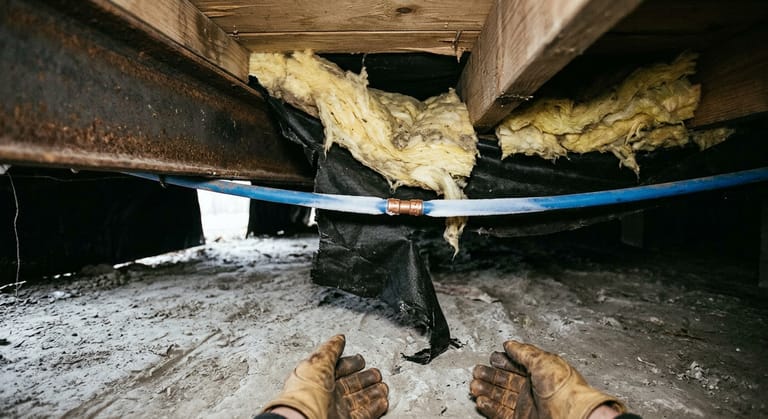
First moves when every tap runs dry
Open the faucet that dead line feeds, and leave it open. Once ice seals the run, the force building behind it has two ways out: a spout standing open, or the weakest fitting on the line. Keeping a tap open relieves that pressure, per the National Weather Service.
Then put a hand on the main valve in daylight. NWS treats this as preventive work: find the shutoff and turn it once while nothing is wrong, because a rupture is a bad moment to be learning a valve. It waits outdoors at the riser, so how to find and work the shutoff valve tonight saves a search at two in the morning.
How to thaw a frozen line without splitting it
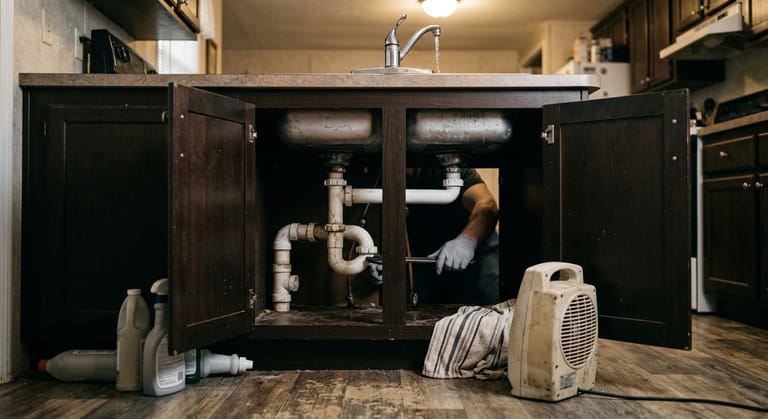
- Open the tap and leave it. Open throughout, so melt water and pressure keep an exit.
- Warm the room around the run. Shut cabinet doors hold room heat off the pipe behind them, so NWS has owners swing open the ones under kitchen and bath sinks.
- Find the cold stretch. Under the skirting, run a hand along the line from the dry fixture toward the inlet. Frost, and a stretch colder than the rest, marks the plug.
- Use gentle heat, never flame. Warm air moved along the pipe, or a heating pad wrapped around it, does the work. No torch, no charcoal, nothing unattended.
- Work from the open fixture back toward the plug. Thawing the far end first traps melt water behind ice, and that pressure splits fittings.
- Stay by the shutoff as it releases. A split announces itself the second flow returns, and somebody at the valve turns a flood into a wet patch.
If the plug sits inside the belly rather than on an exposed elbow, reaching it means opening insulation and bottom board. That is where an owner stops and a plumber who knows these homes starts.
Frozen pipes in a trailer home and older single wides
Age drives most winter callouts. Census Bureau ACS 2024 one year estimates put roughly 23 percent of occupied units in this category before 1980, about two thirds before 2000. Census labels the category mobile home, boat, RV or van, so read the shares as close, not exact.
Under an older home that means patched belly fabric, insulation slumped off the pipes, and supply runs no longer held where they should be.
Talk it through with a mobile home plumber
Call (800) 555-0176Free to dial. You reach a licensed plumber who works on manufactured homes.Partner plumbers who service manufactured homes- Plumbers who actually work on manufactured homes
- Line answered day and night, all year
- Dialing costs you nothing
- Price talk happens between you and the plumber
Thawing a frozen sewer line under the home
A blocked drain in freezing weather feels total, and the HUD standard explains why. The rule at 24 CFR 3280.610(c)(1) runs one sentence: "Each manufactured home shall have only one drain outlet." One outlet, one freeze, every fixture stopped. Slope is the other half. Paragraph 3280.610(h) wants at least 1/4 inch of drop for every foot a horizontal drain line travels, even along its length and leaning toward that outlet, and 3280.610(c)(5) allows the under floor portions to be assembled on site, which is where reversed slope and sags come from. A sag holds water that freezes solid.
Warm air along the run is the tool. Heat cable is not: drain lines appear by name on the list Frost King's instruction sheet forbids, alongside fuel lines and hoses, and CPSC makes the same point, warning that tape bought for water pipe does not carry over to a gutter or a driveway. Keeping mobile home sewer lines from freezing is a grade, support and insulation job, not a cable purchase, and the same goes for the connector out to the lot fitting. If warm air fails and waste backs up indoors, stop and call.
Burst pipe under the floor: shut it down first
Once a line splits, the order is fixed.
- Close the main valve at the riser. What 24 CFR 3285.603(c)(3) accepts there is a full flow gate or ball valve, or an equivalent, so there is a real valve to shut rather than a fitting to improvise around.
- Cut power to an electric water heater. Do that before the tank can run dry.
- Open the lowest taps. Drain what is left, then call.
A split soaks insulation and pools on the bottom board, which is why one burst pipe under the home becomes a floor repair after a day. Photograph the wet area before anything is pulled apart; it shortens diagnosis and invoice.
What frozen pipes in a mobile home cost to put right
No federal source or trade dataset publishes a national price for thawing a belly line, so any page showing one invented it. HomeGuide publishes the nearest numbers, and they are water heater numbers: $45 to $150 an hour and a $50 to $200 minimum call out on its repair page, plus $125 to $300 per labor hour on its installation page where the job means cramped space like a closet. Read them as the shape of a bill, not a thaw rate.
How to keep pipes from freezing under a mobile home
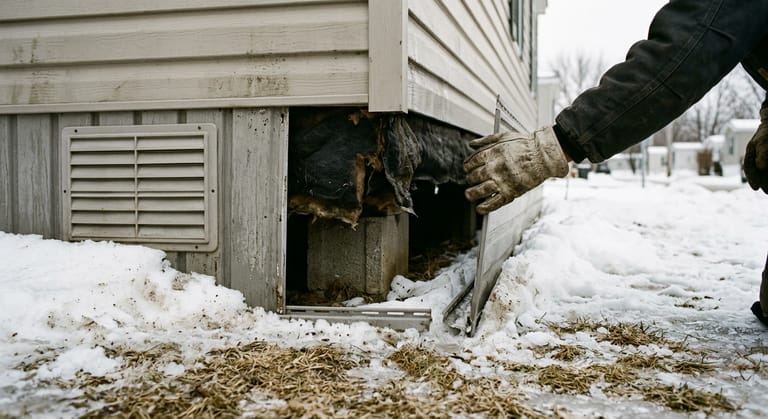
The field guide runs this as a sequence, and the sequence is the point. Nothing gets closed up until the plumbing leaks are repaired. Then the openings: holes through the floor sealed, ducts inspected and sealed, the underbelly rebuilt to hold air out and insulation up, a 6 mil moisture barrier over the crawl space ground. Its sharpest detail is where insulation goes rather than how much. Where freezing is a risk, crews find the water lines first and keep insulation out of the gap between those lines and the warm floor above. Belly paper goes under the pipes instead, the pocket that creates is filled, and the run ends up inside the heated envelope. Insulation on the wrong side of a pipe is what freezes it.
Worth doing before the first hard night
- Reseat every loose skirting panel
- Swing the skirting vent covers shut, the adjustable kind HUD calls for wherever it freezes (24 CFR 3285.505(d))
- Patch belly tears so insulation stays over the pipes
- Bring hot water runs outside conditioned space up to R-3, the DOE minimum at 10 CFR 460.203(d)
- Going away, hold the thermostat at 55 degrees or higher, where NWS draws it
Do not do these
- Seal the skirting around a dryer vent or a combustion air inlet, both of which HUD keeps open to outdoor air (24 CFR 3285.505(f))
- Lay cable over insulation instead of against the pipe
- Buy heat cable without reading what its own sheet allows
- Assume last winter's tape works because it is plugged in
Two federal details are worth checking tonight. First, the cable: HUD lets nothing onto that pipe without a listing or certification for the use it is put to, and binds the install to the sheet its maker supplied (24 CFR 3285.603(d)(3)). Second, the outlet: the home left the factory with one under the floor for pipe heating cable, no more than 2 feet from the cold water inlet, on a circuit protected against ground faults (24 CFR 3280.806). A cable fed by an extension cord is your finding. The full winter prep sequence covers the rest.
When to stop reading and call
- Water is running below the floor and the valve is not where you thought.
- The belly is wet, sagging or dripping after a thaw.
- The frozen run passes a gas appliance, its vent, or heater wiring.
- Heat tape shows charring, a cut or break in its insulation, bare wire, or a surface discolored at the plug, the four signs CPSC tells owners to watch.
Any one of those, dial (800) 555-0176. Nobody is billed for ringing it, the line is staffed through January nights, and the licensed plumber who answers treats a frozen belly line under a manufactured home as a routine winter callout. Haverlane only writes; the wrench belongs to a partner, and the fee a booked job can send back here is never added to what you are quoted.