Mobile Home Toilet Replacement, Start to Finish
The short version
- HUD's construction standard sets the fixture drain under a water closet at 3 inches minimum, and gives the whole home one drain outlet to share.
- The flange and the decking around it decide whether this stays an afternoon or turns into floor work, so read them before buying anything.
- Federal sizing lets a line feeding one fixture run as small as 3/8 inch outside diameter, so the supply stop may not match a site built bathroom.
- Water that ran under the floor means belly work: patch the bottom board, put back any P-trap insulation, resecure lines every 4 feet.
Yes, a mobile home toilet replacement is an afternoon job, as long as the 3 inch drain HUD requires under a water closet is intact and the floor is sound. The toilet itself is ordinary hardware. What it lands on is not, and that is where the day gets decided.
What makes toilet plumbing in mobile homes different
Two lines of federal text explain most of what feels unfamiliar under that floor. The HUD construction standard at 24 CFR 3280.610 sets the fixture drain serving water closets at not less than 3 inches, and gives each manufactured home a single drain outlet. One outlet, one shared path, which is why a plug at the wrong end backs up every fixture at once.
The same section lets the drain lines under the floor be assembled on site by the installer rather than in the factory. Lost slope traces back to exactly that, and the grade the standard asks for is a quarter inch per foot toward the outlet, or an eighth with a full size cleanout at the upper end.
Those pipes sit inside the underbelly, which HUD's installation standard treats as plumbing protection: reseal splits and tears, then check that P-traps stay insulated and covered. Worth seeing how the drain and vent runs first.
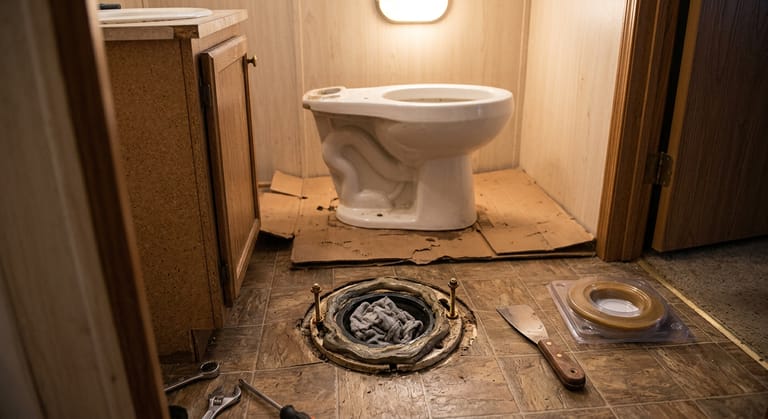
Mobile home toilet replacement parts to set out first
Buy before the toilet comes up. A dry house at 8 p.m. is a poor time to learn when the hardware store closed, and the measurements belong to your home, not to a box.
| Part | Why it matters here | What to check |
|---|---|---|
| Wax ring or waxless seal | Bridges the toilet to the flange | Flange height against the floor |
| Closet bolts and nuts | Hold a heavy fixture to thin decking | Brass, long enough to reach |
| Supply riser and angle stop | Sizing here runs smaller than a house | Thread size at both ends |
| Repair ring or new flange | Why a swap becomes a repair | Material of the pipe below |
| Shims and a short level | These floors are rarely flat | No rock under load |
About that third row: the sizing table in 24 CFR 3280.609 permits tubing as small as 3/8 inch outside diameter where a line feeds one fixture, capped at a six foot run. Not every home is piped that way, which is the point of measuring. Carry the old riser and stop to the counter, or start from the parts guide for these homes.
Shut the water off at the riser, not under the toilet
The main valve usually is not indoors. HUD's installation standard calls for an identified and accessible shutoff valve between the water supply and the inlet, with the riser under or adjacent to the home, and the valve a full flow gate or ball valve. Find it in daylight, not later by flashlight. Never traced yours? Start at where the shutoff valve hides.
Water only, and only water. If the job puts you beside the water heater compartment, shut that circuit off at the breaker and close the gas valve at the appliance first. Gas appliances, their venting and 240 volt connections are licensed work in manufactured housing. Heat tape on the riser gets unplugged before hands go near the pipe.
The swap itself, seven steps
- Close the valve and empty the toilet. Flush, hold the lever down, sponge tank and bowl dry. What stays in there lands on the floor later.
- Break the supply loose at the stop. Hold the valve body with a second wrench, since an old stop twisting in the wall becomes its own repair.
- Pull the caps and closet nuts. Seized brass gets cut rather than fought. The bolt is a dollar, the flange is not.
- Lift straight up onto cardboard. No twisting, so the horn does not drag the old seal across the decking.
- Read the flange and the wood. The decision point, and the next section is entirely about it.
- Set the new toilet in one motion. Line the seal over the bolts, drop it once, press down with body weight. A seal given a second attempt needs a second seal.
- Snug, shim, connect, watch. Alternate the nuts in small turns until movement stops, shim any gap, reconnect the riser, then flush repeatedly with a dry hand around the base.
None of that needs a plumber when the flange is sound. If step five reads badly, stop rather than force a new toilet onto a bad landing.
Talk it through with a mobile home plumber
Call (800) 555-0176Free to dial. You reach a licensed plumber who works on manufactured homes.Partner plumbers who service manufactured homes- Plumbers who actually work on manufactured homes
- Line answered day and night, all year
- Dialing costs you nothing
- Price talk happens between you and the plumber
Mobile home toilet flange replacement, and the floor around it
The flange carries the closet bolts and seals the toilet to that 3 inch drain, so it is what usually fails first here. Age explains most of it: the Census ACS category covering mobile homes puts roughly two thirds of occupied units before 2000 and close to a quarter before 1980 in the 2024 one year estimates, and those floors have been quietly damp around the bolts for years.
Three readings at step five. Cracked flange over firm decking: a repair ring handles it. Sound flange, decking dark and soft under a thumb: the floor is the job now, not the fixture. Flange and closet bend turning together: stop, because the drain below is moving, and torquing a toilet onto it only pushes the leak into the belly.
The first reading is yours. The third is where to stop: a moving bend means opening the belly, rebuilding drain pipe to grade, then closing the wrap properly. Partner plumbers price that from what they find rather than from a menu. Read what a plumbing repair covers on these homes, or dial (800) 555-0176, free, and describe what showed up when the toilet came off.
Belly board replacement under the mobile home bathroom
A leak that ran a while does not stop at the decking. Insulation in the belly holds water like a sponge, and South Carolina's 2021 weatherization field guide lists a torn or missing underbelly among the most serious air leak sites in mobile homes, alongside plumbing penetrations through the floor.
Copy that guide's work order: repair the leak, seal holes through the floor, inspect ducts, then patch the underbelly for airtightness and support. P-trap insulation pulled for access goes back, which HUD states plainly, since those fittings get insulated at the factory precisely because they freeze first. The guide also wants water, gas and electrical lines secured at least every 4 feet to a joist or framing member, so a line hanging under a fresh patch is a checkable defect. More in underbelly repair and HUD's bottom board repair section.
Handle and seat, the two small toilet jobs
Toilet handle replacement in mobile homes needs no shutoff and no wax: unhook the chain, back the retaining nut off, allow for it running the opposite way to what your hand expects, then reverse the process with the new lever. A toilet seat replacement goes the same way in any mobile home, with the wrinkle that old bolts in a damp bathroom usually get cut rather than turned.
Neither is worth a service call on its own.
Gurgling or a lazy flush afterward
When the new toilet empties slowly or the drain gurgles, suspect the vent rather than the fixture. The standard sizes the toilet vent at an area equivalent to 1 1/2 inch nominal pipe, and its table stops a 3 inch fixture drain 6 feet from its vent. Mechanical vents count only as a secondary system, and only where a vent of at least 1 1/2 inches still terminates outside.
Your range here is short: confirm the toilet sits level and seated, check that no rag or wax dropped into the bend, and watch whether other fixtures gurgle in sympathy. Sympathy is the tell, since it points at the shared outlet, not at your bathroom.
Where reading stops and a phone call starts
Call when the closet bend moves, when decking gives underfoot, when water shows in the belly wrap, or when the same seal weeps twice. Haverlane publishes about manufactured housing and owns no tools. Nothing is charged for the call itself, whatever the hour: (800) 555-0176 reaches a licensed plumber whose week already includes homes like yours. A booked job can earn Haverlane a finder's fee on the partner's side, never on your invoice.