40 Gallon Electric Mobile Home Water Heater, Sized for the Closet
The short version
- Nominal capacity is a name: State and Reliance list rated storage of 36 gallons on their 40 nominal electric models.
- Wattage sets the shower. Richmond puts recovery at 17 GPH for 3,500 watts and 21 GPH for 4,500 watts at a 90 degree F rise.
- The bodies measure 22 inches across, so a closet framed to an older narrow tank may not take one.
- HomeGuide puts the unit at $400 to $2,000 and the installed job at $600 to $3,000, plus $125 to $300 per labor hour for cramped access.
A 40 gallon electric mobile home water heater is the largest electric tank built for manufactured housing, and State rates its 240 volt model at 54 gallons in the first hour. No 50 gallon electric unit appears in the manufactured housing lines at A. O. Smith, State, Reliance, Rheem or Richmond, so 40 is the ceiling. Want it settled tonight? Dial (800) 555-0176 and a licensed plumber who works on manufactured homes answers.
What a 40 gallon electric mobile home water heater holds
Nominal capacity is a name, not a measurement. State lists rated storage of 36 gallons on its EN6-40-DMHSW, and Reliance shows the same figure on the 6-40-EMHSDW. First hour rating is the number worth comparing: it folds storage and recovery together.
| Model | Volts | Elements | First hour, gal | UEF |
|---|---|---|---|---|
| State EN6-40-DMHS | 240 | two, 4,500 W | 54 | 0.95 |
| Reliance 6-40-EMHSDH | 240 | two, 4,500 W | 54 | 0.95 |
| Reliance 6-40-EMHSDW | 240 | two, 3,800 W | 40 | 0.91 |
| Reliance 6-40-DHMSE | 240 | two, 3,500 W | 40 | 0.91 |
| State EN6-40-DMHSW | 120 | two, 3,000 W | 40 | 0.91 |
Five badges, two houses: the Reliance, State and A. O. Smith spec sheets all carry the same A. O. Smith address in Ashland City, Tennessee, and Richmond is a Rheem brand. Read the model off your rating plate before you shop.
Volts and watts decide the shower
Richmond states the trade plainly: recovery runs 17 gallons per hour at 3,500 watts and 21 at 4,500 watts, both at a 90 degree F rise. That gap is what a second teenager in the house feels.
The 120 volt option is specific to this segment. State's EN6-40-DMHSW carries two 3,000 watt elements and gives up first hour rating for it, 40 gallons against 54. Reliance even builds single element 120 volt tanks at 1,500 watts, the honest answer to why some homes never had much hot water.
Watch the odd wattages. The Reliance 6-40-EMHSDW uses 3,800 watt elements, and a generic 4,500 watt replacement raises the load the circuit was sized for.
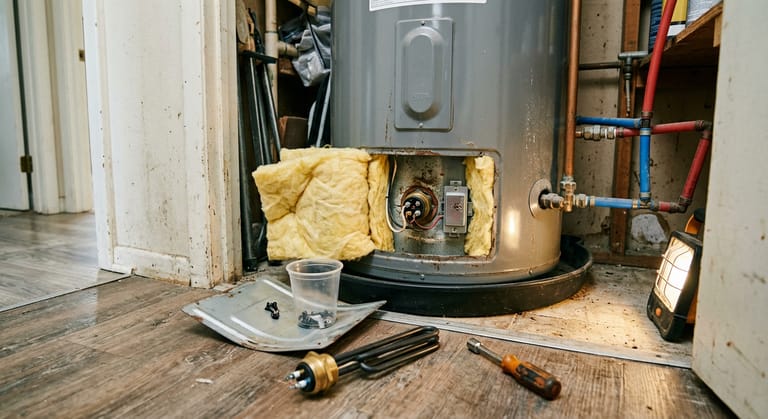
Changing an element with the power off is an owner job. Rewiring, or moving from 120 to 240 volts, is not. The rundown of electric units built for manufactured homes covers the rest of the line.
Why the listing still matters on an electric tank
The HUD code requires a listed water heater in any home with a kitchen sink and a tub or shower, at 24 CFR 3280.609(a)(2), and 3280.709(a) requires each appliance to be installed to the terms of its listing.
For electric storage tanks the code references UL 174, the ordinary household standard, so no manufactured housing test standard exists on the electric side the way UL 307B does on the gas side. What makes a unit a mobile home unit is its shape plus the maker's HUD compliance claim, printed by Rheem as NAECA and HUD certified for manufactured housing.
Shape still rules. Reliance's 6-38EOTT table top holds 38 gallons and carries a HUD compliance bullet, yet it stands 24 inches across with top connections, the wrong body for a closet built around a tall narrow tank. More in the notes on what HUD approval does and does not promise.
Side connections, 22 inches, and the door opening
Electric manufactured housing models put both water connections on the side. Reliance advertises a side mounted cold inlet and hot outlet; State calls it a space saving design. A site built tank with top connections fights the plumbing coming up through the floor.
- Tank diameter. State lists 22 inches on both electric models, 49.75 inches tall at 240 volts and 48.25 at 120.
- The closet opening at its narrowest point, trim and door frame included.
- The pan. 24 CFR 3280.709(h) calls for a corrosion resistant drip collection and drain pan under the tank, draining to the exterior or to a drain.
- What is underfoot. 24 CFR 3280.205 bars carpeting from a space built to hold only a furnace or a water heater.
The code also expects the tank to stay secured against displacement and accessible for service, at 24 CFR 3280.709(a) and 3280.713. If the closet needs reframing, read the walkthrough of a manufactured home install, then hand the framing and the hookup to a pro.
Talk it through with a mobile home plumber
Call (800) 555-0176Free to dial. You reach a licensed plumber who works on manufactured homes.Partner plumbers who service manufactured homes- Plumbers who actually work on manufactured homes
- Line answered day and night, all year
- Dialing costs you nothing
- Price talk happens between you and the plumber
Where the relief line may not go
This is the detail partner plumbers find wrong most often on older swaps. 24 CFR 3280.609(c)(1)(iii) requires the relief discharge to be piped full size, separately, to the exterior of the home and explicitly not underneath it, ending 6 to 24 inches above finished grade, draining by gravity, not trapped, with an unthreaded outlet and a visible end.
If your line disappears below the floor, fix it on the same visit as the swap, and never cut into it while the tank is hot.
What the swap costs
HomeGuide's 2026 national figures put the unit at $400 to $2,000 and the installed job at $600 to $3,000, with labor of $200 to $1,000 covering 2 to 6 hours for a same size replacement. Manufactured homes sit at the friendly end on the tank and the rough end on access.
Price the whole job, not the box.
Repair it or replace it
HomeGuide puts tank life at roughly 8 to 12 years, 15 with maintenance, and suggests replacing past 10 years or when a repair passes half the cost of replacement. These lines carry a 6 year limited tank and parts warranty, shorter than premium site built tiers.
| Job | HomeGuide range | Verdict |
|---|---|---|
| Heating element | $100 to $350 | Worth doing under 10 years |
| Relief valve | $50 to $300 | Never postpone this one |
HomeGuide ties a steady lukewarm supply to a failed upper element and hot water that runs out quickly to the lower one. On single element tanks that fork does not exist, so the check moves to the thermostat and the breaker. Deeper symptom work sits in the troubleshooting notes for these tanks.
When to stop reading and call
Swapping elements, flushing sediment and measuring a closet are owner jobs. Pulling a tank through a narrow opening, rerouting a relief line to daylight, or adding a 240 volt circuit are not.
Dialing (800) 555-0176 costs nothing and puts a licensed plumber who works on manufactured homes on the line. Bring the model number off the rating plate and the width of the closet door. Price is agreed between you and the plumber before tools come out. The rest of the water heater section is here while you decide.