Mobile Home Water Heater vs Regular, What Actually Differs
The short version
- The split is legal, not cosmetic. 24 CFR 3280.709(d) will not let the combustion side of a gas appliance share air with the rooms, which is what forces sealed combustion on the gas side.
- Six visible tells: outside combustion air duct, sealed vent with a separately ordered roof jack, low side cold inlet, side relief valve, anchor brackets, and a closet framed to zero clearance.
- A. O. Smith lists its gas bodies at 18 inches across for 30 gallons, 20 inches for 40 and 22 inches for 50, so the closet, not the gallon number, caps any upsize.
- Richmond puts electric recovery at 17 gallons an hour on 3,500 watts against 21 on 4,500, and 120 volt models exist in this segment, which is why showers here run out sooner.
- HomeGuide prices a 40 gallon replacement at $600-$3,000 installed nationally, then adds $125-$300 per labor hour for cramped closet access, which describes this job exactly.
No, they are not interchangeable. The mobile home water heater vs regular tank question is federal: 24 CFR 3280.709(d) leaves no path between the combustion side of a gas appliance and the indoor air of a manufactured home. A hardware store tank is built the other way.
Electric is the softer case and still not a straight swap. For electric storage water heaters part 3280 reaches for UL 174, the ordinary household standard, with no manufactured housing edition. What sets those models apart is the body, the connections and the HUD compliance claim on the label.
In code: the difference between a mobile home water heater and a regular water heater
It rests on three passages. 3280.609(a)(2) says a home with a kitchen sink and a tub or shower must be given hot water, from a water heater that is listed. 3280.702 defines a direct vent system by where the air moves: all combustion air in from outdoors, all flue gas back out. Then 3280.709(d) closes the door.
24 CFR 3280.709(d) takes one of two answers: a direct vent, sealed combustion appliance, or an enclosure the home's interior cannot open into, no door, no removable access panel, no other opening. The second answer is why so many of these homes carry a small access door on an outside wall, which the code acknowledges at 3280.203 by regulating that door as a combustible surface.
The listing language did shift. Through September 15, 2025, 3280.707(a) pointed at appliances carrying a manufactured home listing; the text now on eCFR will take a residential listing or certification instead. That wording loosened, 3280.709(d) did not, and what HUD approval actually covers follows that split.
Manufacturers say it plainly. A. O. Smith's manufactured housing direct vent manual, part number 315795-000, prints "FOR USE ONLY IN MANUFACTURED HOMES" on its cover and certifies the water heater as a sealed combustion unit with no draft diverter.
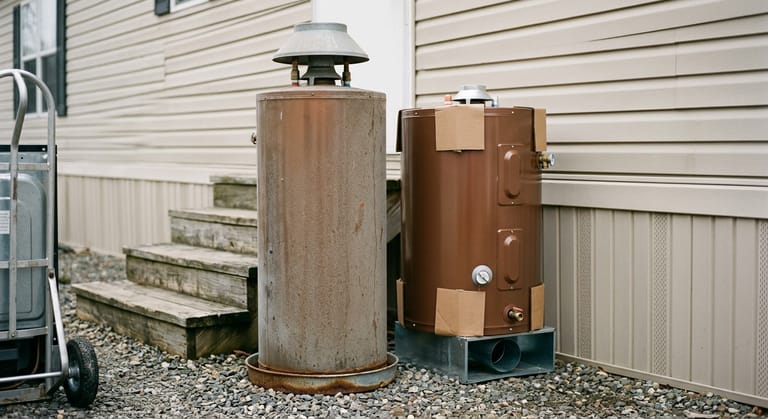
Mobile home water heater vs regular, the six visible differences
Reading the appliance beats reading the box, which is how partner plumbers settle it on site. Every row comes from a manufacturer document or the federal text.
| Difference | On the listed manufactured housing model | Source |
|---|---|---|
| Combustion air | Drawn from outdoors down the furnished intake duct, 3 inch at 30 and 40 gallons, 4 inch at 50 | A. O. Smith manual |
| Venting | Sealed direct vent, no draft diverter, roof jack kit ordered separately in four lengths | Same manual |
| Cold inlet | Low on the side, since supply rises from under the floor, with the hot outlet on top on gas bodies. Richmond co-axial models are the exception, both connections on top | Reliance and Richmond pages |
| Relief valve | Side mounted, no top option on direct vent models, discharge run outside the home rather than under it, ending 6 to 24 inches above grade | Richmond, 3280.609(c) |
| Anchoring | Three brackets into floor and wall, since the code wants appliances secured yet removable | Manufacturer manual, 3280.709(a) |
| The closet | Zero clearance at sides and back, 4 inches jacket front to door, 27 inches jacket top to combustibles, drain pan below, no carpet | Manufacturer manual, 3280.709(h), 3280.205 |
None of the six can be bolted on later: the intake duct, the vent certification and the connections belong to the listed water heater or they are absent, which is why an improvised swap fails inspection. Measuring the closet and photographing the rating plate is homeowner work; choosing the listing is not. There is no charge for dialing (800) 555-0176, and the licensed plumber on the line will read those numbers back with you.
The closet decides the size, not the gallon number
In the field the tape measure rules models out long before the price list does. Zero clearance at sides and back means the closet was framed to the tank. Across A. O. Smith's gas line the diameter climbs 18, 20, 22 inches at 30, 40, 50 gallons, and only the 50 takes the 4 inch intake duct in place of the 3 inch. Two sizes up is carpentry, not a swap.
Capacity labels confuse it further. A 30 gallon nominal gas tank shows 29 gallons of rated storage, and the 28 gallon lowboy sold as the EMHL-30 appears under 30 gallon names at Reliance. Measure the old water heater, read its sticker, and two numbers come back. Both are correct.
Write down three things before shopping: tank diameter, the height of the closet opening, and whether the vent leaves through the roof. The [installation walkthrough for these closets](/water-heaters/installation/) turns them into a parts list.
Talk it through with a mobile home plumber
Call (800) 555-0176Free to dial. You reach a licensed plumber who works on manufactured homes.Partner plumbers who service manufactured homes- Plumbers who actually work on manufactured homes
- Line answered day and night, all year
- Dialing costs you nothing
- Price talk happens between you and the plumber
Electric models: 120 volts, single elements, slower recovery
Here the catalogue splits in a way no site built line does. State's EN6-40-DMHSW runs on 120 volts at 3,000 watts for a 40 gallon first hour rating, while the 240 volt twin at 4,500 watts posts 54. Reliance sells single element bodies at 1,500 watts. Richmond prices the trade: drop from 4,500 watts to 3,500 and hourly recovery falls from 21 gallons to 17.
That spread explains the shower that turns cold halfway through. It also changes diagnosis, since HomeGuide reads lukewarm water as a failed upper element and a fast runout as the lower one, a fork that does not exist on a single element water heater. The electric models built for these homes go further.
Wattage holds one trap. Reliance lists model 6-40-EMHSDW at 3,800 watts, and a generic 4,500 watt element can push past what the circuit was sized for.
No element or thermostat comes out until the breaker is off and the circuit is proven dead. Anything at 240 volts, and every part of a gas installation, belongs with a licensed professional: shut the gas valve and call rather than open a burner compartment.
What an Intertherm water heater means for mobile home replacement
Owners often arrive with a brand read off a badge, and Intertherm is one of those names. Nothing in the federal text ties a replacement to the old badge: 3280.609(a)(2) asks for a listed water heater and 3280.709(d) asks for sealed combustion or a sealed enclosure. A tank meeting both is lawful whatever name is stamped on the original.
Haverlane publishes no specification it has not read at source, and no Intertherm document sits behind this page, so nothing here describes one. Identifying your own equipment is documented: the home's data plate has to name every major factory installed appliance by maker and model designation, and HUD points owners to a kitchen cabinet, the electrical panel or a bedroom closet.
Photograph that plate and the rating label on the tank before calling anyone. Matching a badge is guesswork; matching a listing, a diameter and a vent route takes five minutes on the phone.
What the wrong water heater costs to undo
HomeGuide's 2026 figures cover all housing types, with no separate series for manufactured homes, so read them as a baseline rather than a quote. Installed, the span is $600-$3,100, narrowing by size: $500-$1,900 at 30 gallons, $600-$3,000 at 40, $700-$3,100 at 50. Labor by itself is $200-$1,000 for the two to six hours a same size swap takes.
The difficult installation surcharge dominates: in cramped space, a closet being the example, HomeGuide adds $125-$300 to each labor hour. Here that is normal, not exceptional. Beside it sit vent replacement, $100-$600; the permit, $50-$200; hauling the old tank away, $75-$500; and $250-$900 more if a dedicated circuit is pulled.
All four manufactured housing lines carry a 6 year limited tank and parts warranty, shorter than the premium tiers sold for site built homes. Worth knowing too: Reliance, State and A. O. Smith are one corporate family and Richmond is a Rheem brand, so four badges are really two engineering houses.
Where reading stops and dialing starts
- Read the plates. Two photographs: the rating label on the water heater, then the data plate inside the home.
- Measure the opening. Diameter, height and door width, in inches. That rules models in or out.
- Check the vent route. Note whether it exits through the roof, and whether the cold line enters low on the side.
- Hand it over. Gas piping, venting and 240 volt circuits are licensed work, and the listing question is not a coin flip.
Everything above the last step needs a phone and a tape measure. Below it, the risk stops being financial. (800) 555-0176 is free to dial at any hour, and the licensed plumber who answers spends the week inside closets like yours. Bring the photographs and the measurements, and the mobile home water heater vs regular question is settled before anyone drives out.
Talk it through with a mobile home plumber
Call (800) 555-0176Free to dial. You reach a licensed plumber who works on manufactured homes.Partner plumbers who service manufactured homes- Plumbers who actually work on manufactured homes
- Line answered day and night, all year
- Dialing costs you nothing
- Price talk happens between you and the plumber